
Grand County Court Records After Arrest
Grand County court records after arrest are tied to a local filing decision. The arrest and booking can happen first at Grand County Jail, but the court record starts to take shape when a case is filed in the right court. The Grand County Attorney Criminal Division prosecutes crimes that occur in Grand County. Felonies and Class A misdemeanors go to Seventh District Court. Class B misdemeanors, Class C misdemeanors, and infractions committed in Grand County but outside Moab City go to Grand County Justice Court. Youth offender cases are handled in Seventh District Juvenile Court.
The jail side and court side should stay separate in a record search. The public jail list may show a booking number, name, statute, offense, court, offense code, and class. That is a custody and offense-list record, not proof of guilt. The court case may later show filed charges, amended charges, hearings, warrants, pleas, dismissals, financial sanctions, and disposition details. For current custody and booking fields, use the Grand County jail inmate records path. For booking-photo access, use the Grand County jail mugshots path. The court record controls the formal case history.
Find Grand County Court Records
Utah Courts describes Xchange as a public repository for district court and justice court case information. That makes Utah Xchange the broad public starting point after a Grand County jail arrest. A person can search as a guest or with an account depending on the access needed, and Utah Courts also notes that free public Xchange access is available at most district courthouses and may be available at some justice court locations. If the roster gives only a name and offense, a party-name search is usually the practical route.
The Xchange help material warns that case numbers and citation numbers are not unique statewide. Narrow the search to Grand County, the court, or a date range when possible. A partial name with a wildcard can help when a middle name, suffix, or spelling is not clear from the roster image. Birth date may help separate similar defendants, but public screens may not show a full birth date in every case.
The official Xchange search screen is shown in the Utah Courts Xchange application.
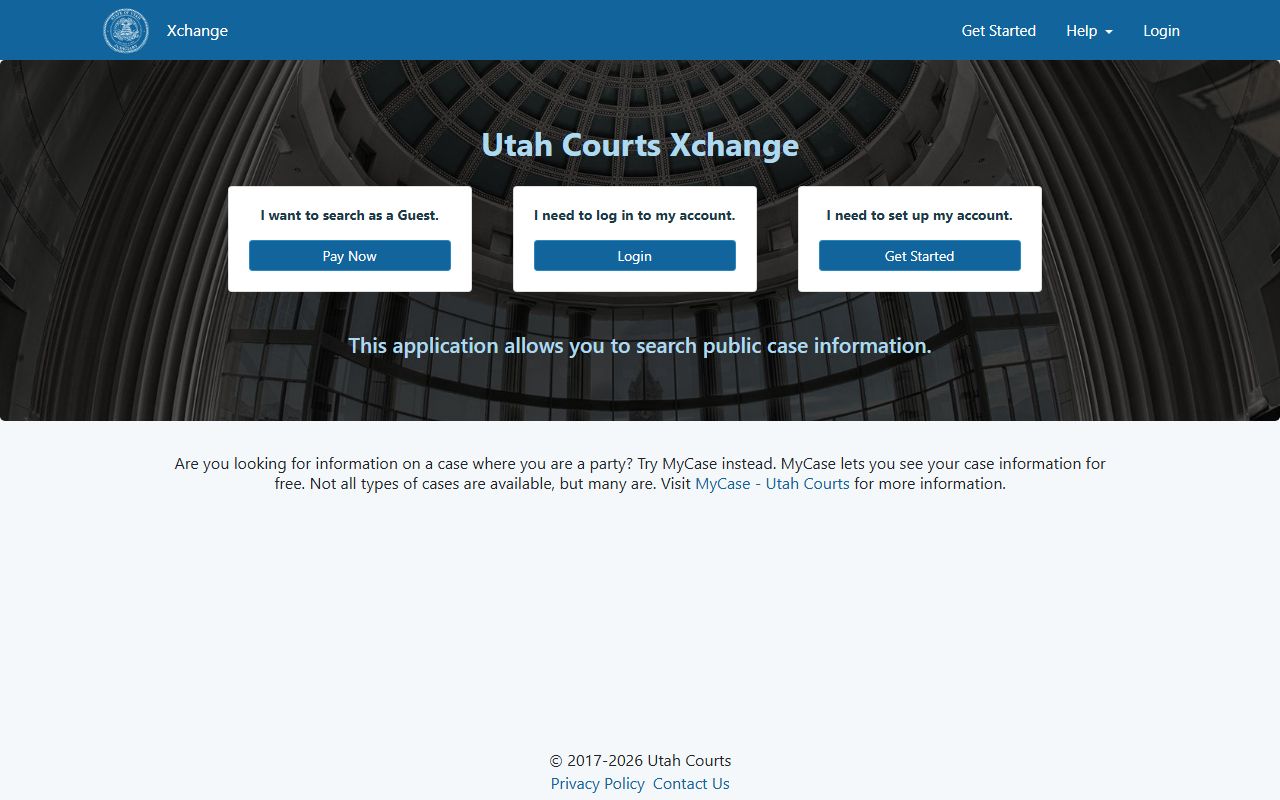
Xchange is the court search tool. It does not replace the jail roster, the prosecutor's filing decision, or a GRAMA request for police reports.
| Field Label | Type | Required | Options or Format Notes |
|---|---|---|---|
| Jurisdiction | Dropdown or filter | Optional | Use District Court, Justice Court, or both. |
| Search type | Option or filter | Optional | Search all court cases or only judgments entered. |
| Case number | Text | Optional | Not unique statewide, so narrow by county or court. |
| Party name, last or company | Text | Needed for name search | Utah Courts help recommends wildcard use. |
| Party name, first | Text | Optional | Narrows the result list. |
| Case type | Dropdown or filter | Optional | Narrows by case category. |
| Search scope | Dropdown or filter | Optional | Search statewide, by county, or by specific court. |
| Birth date | Date | Optional | Often available only for criminal defendants. |
| Citation number | Text | Optional | Also not unique statewide. |
| Date range | Date range | Optional | Useful when the arrest date is known. |
Grand County Charges and Courts
The prosecutor matters because an arrest does not file its own final charges. The Grand County Attorney is Stephen Stocks, an elected county prosecutor who is independent of the Utah Attorney General. The Grand County Attorney office is listed at 25 S. 100 E., Moab, UT 84532, with administration phone 435-259-1324. The Criminal Division works with the Grand County Sheriff's Office, Moab City Police, Utah Highway Patrol, and other law enforcement agencies when prosecuting local criminal cases.
For court routing, Grand County uses both district and justice court channels. Seventh District Court handles felony and Class A misdemeanor criminal cases for Grand County. The Grand County courthouse contact listed by Utah Courts is 125 E. Center St., Moab, UT 84532, with phone 435-259-1349. Grand County Justice Court handles infractions, Class B and Class C misdemeanors, traffic matters, river-runner safety citations, and small claims. The county bail page lists Justice Court at 435-259-1334.
| Office or Court | Role After Arrest | Contact |
|---|---|---|
| Grand County Attorney | Stephen Stocks, elected county prosecutor | 25 S. 100 E., Moab, UT 84532; 435-259-1324 |
| Grand County Attorney Criminal Division | Routes felonies and Class A misdemeanors to district court, and some Class B/C and infraction matters to Justice Court | Criminal Division page |
| Seventh District Court, Grand County | Felony and Class A misdemeanor criminal cases | 125 E. Center St., Moab, UT 84532; 435-259-1349 |
| Grand County Justice Court | Class B/C misdemeanors, infractions, traffic, and river-runner safety citations within its local scope | 125 E. Center St., Moab, UT 84532; 435-259-1334 |
Grand County Charging Records
A court record after a jail arrest is usually built around a charging document. The jail booking may list an offense, statute, court, and class soon after arrest. The prosecutor may then file a complaint, information, or in rare serious cases an indictment. The court record may use different wording from the jail offense list because charges can be screened, amended, reduced, dismissed, or replaced after the arrest.
| Document | Filed By | Common Use | What to Check |
|---|---|---|---|
| Complaint | Officer, prosecutor, or court process depending on case type | Often used to start misdemeanor or early criminal proceedings | Name, statute, offense level, filing date, and court |
| Information | Prosecutor | Common charging document for many felony and Class A misdemeanor cases | Counts filed by the Grand County Attorney and any later amendments |
| Indictment | Grand jury | Less common in routine local cases, used for serious charges when returned by a grand jury | Counts returned, court assignment, warrant or summons status |
Police reports are not the same as filed court records. Grand County's sheriff records page says police reports generally may not be released until they have been adjudicated or processed through court. It also says defendants in unadjudicated cases who do not have an attorney should obtain copies through discovery at the Prosecuting Attorney's Office, while represented defendants should have their attorneys request the report.
Grand County Charge Status
Charge status is the part of a court record that changes as the case moves. A pending charge is still open. An amended or reduced charge has changed from the original filing. A dismissed count was removed or ended without a conviction on that count. A disposition is the final outcome. A conviction means a plea or finding of guilt. It is not the same as an arrest or jail booking.
| Status | What It Means | Why It Matters |
|---|---|---|
| Pending | The charge has been filed but not resolved. | The person is still presumed innocent while the case is open. |
| Amended | The prosecutor or court changed the charge. | The active court count may differ from the jail offense list. |
| Reduced | The charge was lowered to a less serious offense. | Case level, penalties, and court handling may change. |
| Dismissed | The count was terminated without conviction on that count. | A dismissed charge is not a conviction, though records may still exist unless sealed or expunged. |
| Disposition | The final outcome of a charge. | This is the key field when checking whether a case ended in conviction, dismissal, or another result. |
Charge versus conviction: A charge is an accusation filed in court. A conviction is a plea or finding of guilt. A jail arrest, booking entry, or pending charge should not be read as a conviction.
| Record Point | Charge | Conviction |
|---|---|---|
| Stage | Filed accusation in a pending or resolved case. | Final plea or finding of guilt. |
| Source | Charging document, docket, or amended filing. | Disposition, judgment, or sentencing record. |
| Meaning | The allegation must still be proved or resolved. | The court has accepted or entered guilt on that count. |
| Roster Link | May differ from the booking offense list. | Cannot be inferred from the booking entry alone. |
Grand County Bond Path
Bond details may appear in court records, on a court order, through a court clerk, or through a sheriff GRAMA response. Grand County's bail page says the 7th District Court and Justice Court take credit-card bail or bond Monday through Friday, 8 a.m. to 5 p.m. The page lists 7th District Court at 435-259-1350 and Justice Court at 435-259-1334. It also states that the jail cannot take credit-card bail or bond. If a physical bond process is needed, the county page says bonds are done at the North Door using the 100 North Street entrance.
The Grand County bail procedures page shows the local court-based bond route.
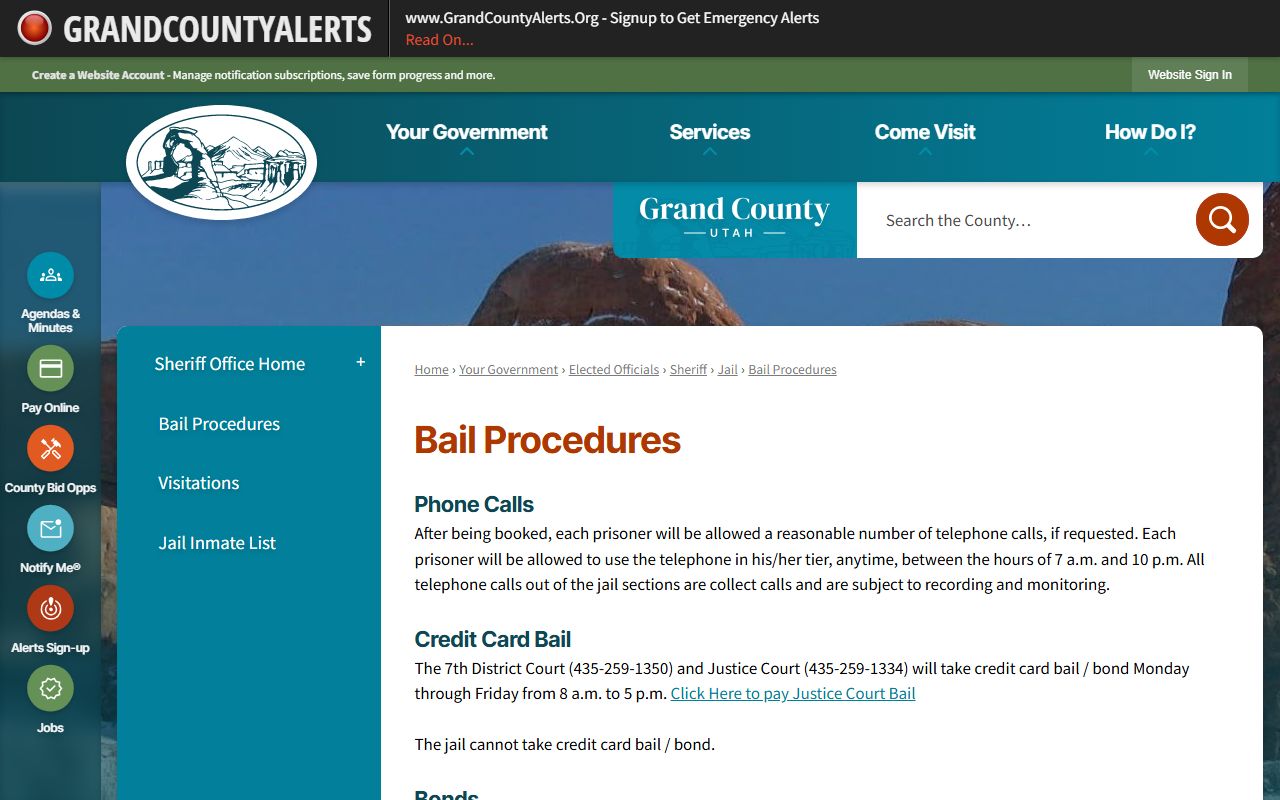
Bond can secure release while a case proceeds, but it does not erase charges or end the court record.
| Bond or Release Type | How It Works in Grand County |
|---|---|
| Cash or credit-card bail through court | Court-handled payment during listed court business hours. |
| Jail credit-card bail | Not available according to the county bail page. |
| Surety bond | Posted through an approved Utah bail bond company. |
| Personal recognizance | Release without upfront money if ordered by a judge. |
| No-bond hold | Release may be blocked by a court order, warrant, parole hold, immigration hold, federal matter, or another agency. |
Warrants After Grand County Arrest
No official Grand County Sheriff's Office active warrant list was located on the county sheriff or jail pages during research. The official statewide entry point is the Utah Bureau of Criminal Identification warrant-check page, which links to the statewide warrant search application. The direct application returned a browser access block during research, so the BCI page is the source to use first.
A warrant can connect jail and court records. An arrest warrant authorizes law enforcement to arrest a person. A bench warrant is issued by a court, often for failure to appear or comply with a court order. A search warrant authorizes a property or evidence search, not custody by itself. A fugitive or hold warrant can involve another jurisdiction seeking custody. If a warrant arrest results in booking at Grand County Jail, the person may appear on the jail inmate list, but warrant type, issuing court, bond amount, and status may be clearer in court records.
| Channel | Use |
|---|---|
| Utah BCI | Official statewide warrant-search entry point. |
| Xchange | Search court cases for hearing, failure-to-appear, or bench warrant activity. |
| Grand County Jail | Call 435-259-8115 if a person may have been booked on a warrant. |
| Attorney or court | Resolving a warrant usually requires court instructions, counsel, bond, or appearance. |
| GRAMA | Use a sheriff records request for releasable records not online. |
Grand County Record Limits
Utah's Government Records Access and Management Act, or GRAMA, sets the public-records path for many jail and law enforcement records. Utah Code 63G-2-201 gives a person the right to inspect and copy public records unless the record is private, controlled, protected, or otherwise restricted. Utah Code 63G-2-204 covers written requests to the government entity that keeps the record. For Grand County booking records, that often means the sheriff's office.
Grand County's local records guidance says adult arrest information may include an adult defendant's name, age, description, town of residence, arrest photos, charge text and source, arraignment dates, and bond amounts when the record can lawfully be released. It also says not all requests can be granted, and denials should include a reason. Juvenile information generally is not released unless the juvenile is certified as an adult by a state judge. Ongoing investigations, privacy interests, safety issues, fair-trial concerns, and protected records can lead to redaction or denial.
Discovery is different from a public-records request. Discovery is the case evidence exchange used in a pending criminal case. Grand County's records page directs some unadjudicated defendant requests to the Prosecuting Attorney's Office and represented defendants to their attorneys. That limit matters when someone wants police reports rather than the public court docket.
Sealed and Expunged Records
Utah record clearing uses Title 77 Chapter 40a pathways. Utah Code 77-40a-201 covers automatic expungement or deletion pathways, while Utah Code 77-40a-305 covers petition-based expungement. Eligibility depends on the case result, offense type, waiting rules, and court process. A dismissal may support a clearing path, but it does not mean every public record vanishes on its own the same day.
| Record Status | Plain Meaning | Practical Effect |
|---|---|---|
| Public | Available unless a restriction applies. | May appear in Xchange, court access, or releasable GRAMA records. |
| Sealed | Hidden from ordinary public access. | Some agencies or courts may retain limited access under law. |
| Expunged | Cleared through a Utah expungement process. | Public access is restricted according to the expungement order and statute. |
| Protected or private | Restricted by GRAMA or another law. | The custodian may deny or redact the requested record. |
Important: A casual court lookup is not a full Utah criminal-history check. Utah Code 53-10-108 controls state criminal-history access and dissemination separately from a jail roster or court docket.